Category Archives: General Archery Chat

Dan – Traditional Bows : a Beginner’s Guide to Wooden Longbows

I got my first traditional bow last year and I was happily hooked soon thereafter. Even if I am wielding something that is more usually found in the gloomier regions of the Amazon Rainforest in an indoor hall near London Bridge it’s still rather a lot of fun! I soon decided to look into buying something better. What followed were many weeks trawling through the internet looking at random bits of tree and talking to some spectacular beards, and as such I thought it might be worth passing on some useful little tips which I picked up. 

Modern traditional bows are an oxymoron as they are normally made up of 2 or 3 layers of wood called laminates. This is because different parts of the bow require different technical properties, specifically the ability to withstand compression or tension, and it’s impossible for one type of wood to do both equally well. Laminate bows therefore utilise woods with different types of properties in different parts of the bow which makes them better but more expensive than single piece self-bows.

Your bowyer will be able to give you detailed expert advice on the best types of wood to use and different bowyers prefer different types of wood. The following however is a good starter for 10, regardless of whether you go for an off-the-shelf bow or a more tailored one.

Bellywood. The belly of the bow is the part of the bow which is closest to the archer, and requires a wood which is capable of withstanding compression. The most common bellywood is Lemonwood which is cheap to use and found in most traditional bows. It won’t last more than a couple of years though before it starts to have a bend in it called string-follow, but it is excellent for a first traditional bow. [NB according to many bowyers, string-follow actually improves the performance of a bow, so like wine your bow will improve with age!]

Other bellywoods include Ipe, Yew, Osage Orange and Putu Jumau. Each of these is excellent under compression making them ideal for the belly of a bow, if in doubt, go for the one whose colour you like best – a traditional bow can, and indeed should, be something beautiful.

Corewood. The core or middle of the bow is the foundation of the bow and is typically made of a very hard wood, indeed the harder the better. The most common are Purpleheart or Greenheart which are excellent corewoods and, because of their availability, they are cheap.

Other corewoods include Balau [“harder than the knockers of hell” as one chap colourfully described it], Ipe, Yew, Padauk, Bubinga, Snakewood and a whole host of other woods I have never heard of – as with bellywood if in doubt go with the one whose colour you like best. 

You will note that Yew and Ipe, and indeed several others, can be used as both core and belly woods, in such a case you would end up with a bi- as opposed to a tri-laminate bow. 

Backwood. The back of the bow is the part of the bow furthest from the archer and requires a wood which is capable of withstanding tension. By far the best backwood is Bamboo, which unfortunately is also the most expensive. If you are buying a tailored bow, it is worth sacrificing cost elsewhere in the bow to be able to have a Bamboo back. Hickory or Maple are also perfectly good choices for heavy (60lb’s or more) and lighter bows respectively.

Traditional bows come in a whole host of different types, shapes and sizes from delicate flat bows to 140lb warbows, each of which however will incorporate the ideas discussed above. Go on give it a go, you won’t regret it!

Archery for Beginners

Archery is one of the fastest growing sports in the UK. Open to all, archery can be enjoyed by young and old, people with disabilities and whole families (2020 has a great junior club with Mums and Dads shooting alongside young people each weekend – www.juniorarchery.co.uk). 

As a sport that can be practiced inside or outside throughout the year, socially or competitively, archery can really be said to cater for everyone. Over here at 2020 Archery we currently have 1 completely blind club member and 1 with significant visual impairment. We’ve also had a number of wheelchair users and people with mobility issues as members in the past. 

Forms of archery

Target archery: this is the most popular form of archery in the UK and the style that is currently featured in the Olympic games (although the Olympic version is somewhat different than regular competitions). Target archery takes place on flat ground – indoor or outdoor – and involves shooting a specific number of arrows at particular sizes of target faces at 

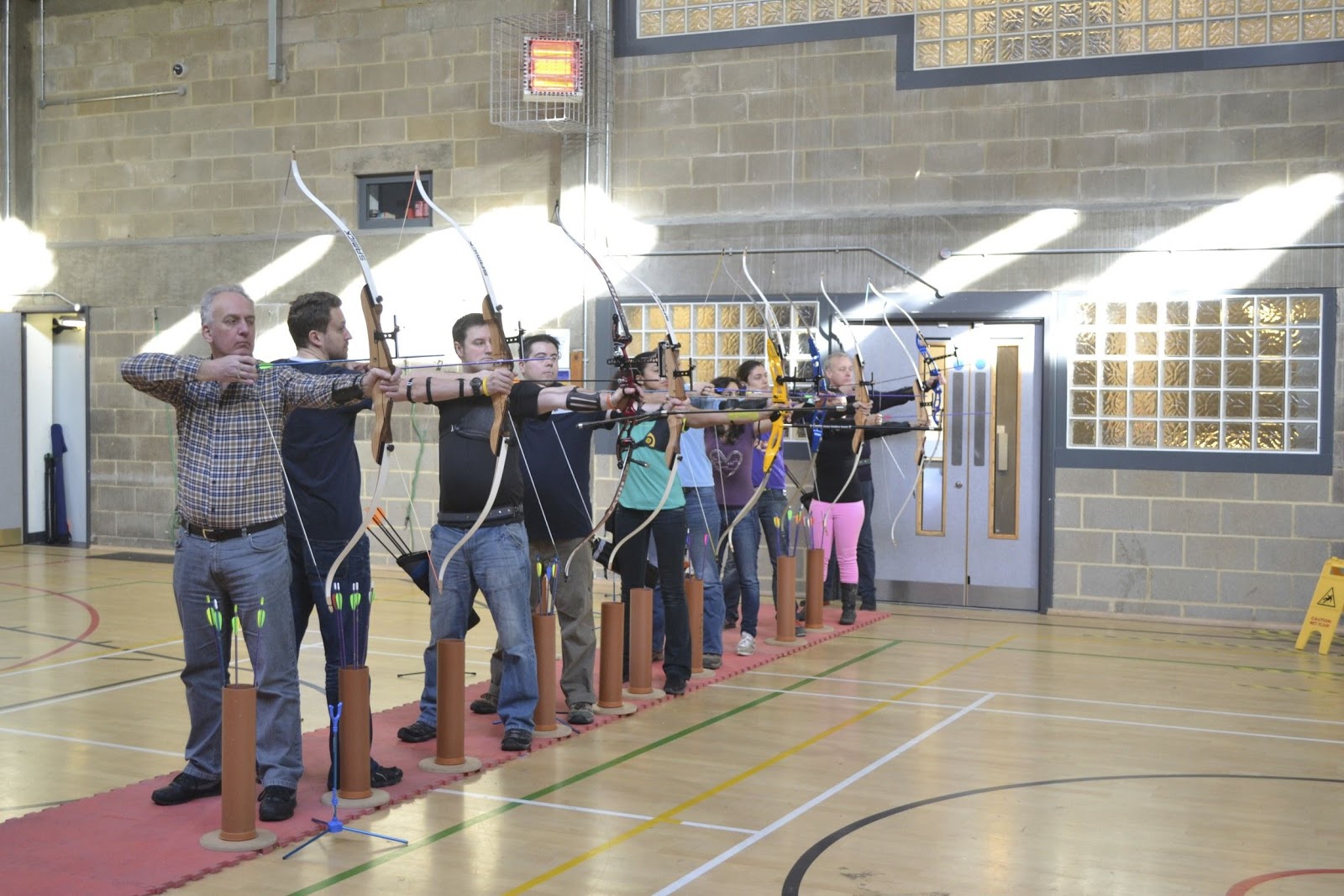
distances of up to 100 yards. This type of archery can also take place inside over shorter distances. Indoor archery – like we do at 2020 – typically sees us shooting 5x dozen arrows at 60cm target faces for a score out of 600 at 20 yards. You can see our club members scores on the club website here (http://www.2020archery.co.uk/club-6/)


Field archery: this form of archery takes place on a series of targets set out in outside locations, often in woodland. The shooting distances are usually unmarked so archers rely on their judgement and instinct, especially if they choose to use a traditional bow such as a longbow or flatbow. Saying that, I also know a number of compound archers who also enjoy this type of more ‘natural’ shooting.  

Clout archery: this form of archery is similar to target archery but the archer must drop the arrows at a long range into a number of circular scoring zones on the ground. Arrows are shot at an angle of around 45 degrees up into the air. This type of archery probably emulates the kind of military training that used to take place when an enemy might be a known distance away (e.g. approx 150 yards) and accuracy at the specified distance could mean victory or defeat.  

Flight archery: requiring a lot of space, flight archery is a sport in which the archer must shoot the arrow as far as possible. This is generally done in very specific categories for weights and types of arrows shot from specific bows. James Farrar of Fairbow holds a number of flight records using very heavy traditional bows known as warbows – he also sells great traditional archery gear which we like a lot over at 2020 (http://www.fairbowuk.com/). 

Getting involved 

There are a number of ways that you can get involved in archery but the best place to start is your local club. Most clubs are very welcoming to beginners (as long as you’ve made an appointment or booked a session) and many offer Have-a-Go sessions. This gives newcomers the opportunity to try out the sport before enrolling in a beginners course and – hopefully – becoming a member and starting to practice with the club. 

Although clubs often welcome beginners, it is important to have a basic understanding of the sport before you try to join a club or start practicing.  Most clubs will offer structured beginners courses to set up would-be archers with the basic skills and techniques required. The course can take place across a number of weeks or over a weekend and gives new archers the opportunity to join an archery club for further training and the chance to compete in tournaments if they want to. 

Archery on Horseback

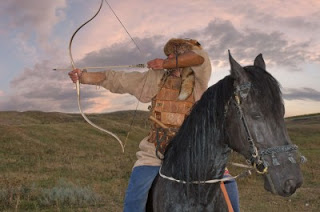
You’d be forgiven for believing that archery on horseback was a thing of the past, a form of iron age hunting and fighting that has long since disappeared. But mounted archery has far from died out. It’s unlikely that it still takes place in the traditional way for hunting or in aggressive situations, but instead it has become a popular sport, with competitions taking place in the UK and across the globe.


A little history

Although it was once a popular method of assault in fast attacking raids, mounted archery was an ineffective defence against massed foot archery in more formalised battle settings. Large numbers of foot archers were able to synchronise attacks on their large targets and achieve a longer range than their mounted enemies. In fact, mounted archery was such an ineffective defence that Mongol archers would often dismount and shoot from a sitting position!

Mounted archery began to disappear in the 17th century when modern firearms became common weapons. During the next century, bows were occasionally used in conjunction with firearms, providing archers with the benefits of both. However, as repeating firearms were developed, mounted archers were removed from battle completely.


After Mongolian independence in 1921, mounted archery enjoyed a resurgence as a cultural display at festivals showcasing Mongolian heritage. Its instant popularity – and huge visual appeal – sparked a worldwide interest and mounted archery began to be reintroduced across the world. 

Competitions today

Nowadays, mounted archery is a rapidly growing equestrian sport, popular in a large number of countries including the UK, the USA, Germany, China and Korea. The sport has come a long way from its origins and now uses a light weight (under 50 Ib) bow and a guided track to keep the horse straight.  

There are a number of annual competitions held all over the world, with the largest held in Korea. In order to embrace the sport’s history, competitors often wear the traditional clothing and use traditional bow and arrows rather than those used in modern foot archery.

In general, the competitions are split into two groups: Korean style and Hungarian style. The Hungarian style involves one run on which the archer must hit three targets from three different angles, the reverse angle being the most difficult (obviously!). The Korean style involves three different runs that vary in difficulty, the hardest being the 5-shot serial run which requires the competitor to loose the arrows quickly between targets. All mounted competitions include time penalties and points for accuracy making it a difficult balance between completing the course in the allotted time – and actually hitting stuff. 

The Korean style competitions also include a game called Mogu. In Mogu, the mounted archer must chase after a ball being dragged by another horse. They are required to shoot at the ball with ink-dipped arrows and the number of ink stains is counted to determine the score. This also requires a horse with nerves of steel (or good protection at the back – not sure I’d want to try this one myself unless I’d got a LOT of practice in)! 

Getting in to mounted archery

Many mounted archery beginners start out as horse riders with an interest in picking up archery. If you have previous horse riding experience, a few beginners’ archery lessons may be all you need before you’re ready to start competition training with your local club. 

For those with no previous horse riding experience, regular non-mounted archery is a great place to start. Taking part in a beginner’s course gives you the opportunity to try out the sport or archery in general while picking up the basic skills needed for mounted archery. For information about 2020 Archery’s Have A Go sessions where you can get started for only £20, click through to our main website here https://www.2020archery.co.uk/lessons-courses/have-a-go or call 0203 130 6797.

Josie : Shooting at 2020.. Do’s and Don’ts

While we’re here we might as well cover all the bases. This is by no means a definitive list but covers many things I’ve come across in my time at 2020. There are no doubt things I’ve missed, and perhaps some should be expanded upon, but for what it’s worth this is my 2020 “Do’s and Don’ts” Guideline List…

>>—->  2020 uses whistle codes on the shooting line. Please listen out for them! The safer we stay, the more shooting we can pack in.

>>—-> The shooting line can get very busy: be aware of where the ends of your limbs and arrows are at all times.

>>—-> Don’t run with arrows. The quicker we clear the butts and get safely back behind the line the more ends we can fit in, but never compromise safety for speed!

>>—-> The butt you are shooting on is your responsibility. Ensure the legs are always in the correct position.

>>—-> Be respectful of other archers and their kit – this includes club equipment too!

>>—-> Never distract an archer once they’ve started drawing.

>>—-> Never nock your arrow off the shooting line.

… and some positives:

>>—-> Have fun! If you’re not shooting well and getting frustrated your form will deteriorate. Take a break and clear your mind.

>>—-> On the other end of the scale, if you’re shooting well don’t let it go to your head – over-confidence will mess up concentration in exactly the same way as frustration.

>>—-> Not sure about something? Ask! There are plenty of coaches and club members milling around, don’t be afraid to ask questions (even if the question may seem silly – we were all beginners once).

>>—-> If you’re looking to purchase a new bow why not ask some of the club members if you can try theirs? Be prepared that they may not all say yes but it’s worth asking.

>>—-> When you’re struggling with technique (as we all do at times) ask someone on the line to watch you shoot and offer comments. Better still, if they can video you on their phone that will give you plenty of information to work with. If you’re anything like me you’ll hate seeing yourself on film, but it really works.

Anyone else? The floor is open to bidders…

Roger : An Archers Path by Roger Huggins

Hi, my name is Roger and I’ve been shooting all sorts of bows for about 6 years. I’ve been teaching modern recurve archery at 2020 Archery for the past 8 months during which time I have taught over 200 people and counting. I learnt to shoot while I was at university in Sheffield with a recurve training bow. I was fortunate enough to be able to shoot compound bows and modern recuves after which I bought myself a very nice long bow which I still shoot today. I have a love of historical archery and own – or have owned – a long bow, a horse bow and a Chinese repeating crossbow.
 
Last year I came back to modern recurve archery when I started using them to teach beginners. To refresh and expand my knowledge I read several books on archery and coaching (more of this later) and I also started practicing with the recurve several times a week. After a few months of practicing and improving my form with a training bow I started building my dream recurve. Components started trickling in during September 2012 with the aim of having everything together ready for me to start shooting in competitions early in 2013.
 
Which neatly brings me to the aim of this blog, over the next few months I am going to share my experiences of my journey along the path from being a seasoned traditional archer, through intermediate archer, to (hopefully) competitive modern recurve archer.

Hopefully this will be interesting.. and hopefully it will also help beginner and intermediate archers avoid some of the pitfalls and problems that I’m encountering myself. I’m also working with a few people at the club trying to sort various issues which I’ll be able to share with you. I’ll be offering suggestions on how to move forward with your archery if you find yourself getting stuck in a rut, whether its getting over a slump or just looking to get something more from archery than shooting a few ends in your club once a week (not that there’s anything wrong with shooting a few ends once a week!). 
 
Well that’s more than enough about me, my next post will be on improving your knowledge to improve your shooting, what books to read and when and how to get the most out of watching the professionals.

Josie : At the forefront of a sweeping tide of history

Hi everyone, how’s the shooting going?

I thought I’d give you a bit of a clue what’s to come before we dive in. I’ll let you know how things are going with me – I have some bow upgrade work planned soon of which I’ll keep you informed, it should be quite exciting. However, I also want to share some thoughts and ideas which have helped me become a better archer over the past 8 months. If I come across something really useful I’ll pass it on. Who knows? It might just be the key you were looking for…

Technique is obviously a big thing to bear in mind, equipment is another. I’m probably not best-placed to comment on these but I doubt that’ll stop me and I hope someone will correct me if I’m wrong!

Then comes the psychology of archery which is perhaps something I can comment on. This is probably one of the most difficult hurdles, especially if you shoot in one of the busy sessions. Tricky keeping your calm rhythm when someone behind is poking you with their short-rod!

However, one can’t expect to always be in a zen-like atmosphere at every shoot. I imagine competition is far from it, not to mention the added pressure of graded performance. It’s up to you alone to create the perfect conditions for shooting and this can all be done from the comfort of your own head.

The beauty of archery is that it’s changed very little since the Dark Ages. The function may have evolved but the raw fundamentals remain intact. This is handy as we can safely draw on references from right the way through history and apply them to the present day. For instance, did you know that the first recurve bows were shot by the Assyrians around 1000BC? That’s not even the oldest form of archery. Have a look at some of the early archery manuals here:

The object may be different but the rest isn’t. Nice to know we don’t exist in a vacuum.

To all the new archers out there: welcome to the forefront of a sweeping tide of history! Glad you could join us…

Josie: Good Morning Ladies and Gents….

–>

Good morning ladies and gents, my name is Josie and I shall be one of your flight attendants on this voyage. Please read the safety instructions provided and ensure your seat belt is engaged. One of my colleagues will be along shortly with the menu, so sit back and enjoy the ride…
I’ve been shooting with 2020 since last April (2012) after doing the 5-week intro course with Asher. I had shot before back in Devon in a casual way so it was great to finally get a decent grounding in proper archery technique. Immediately afterwards I joined the club and there aren’t many weeks I haven’t shot since. It’s seriously addictive!
My first bow was purchased back in August last year. After much deliberation, questioning club members and a bit of testing I settled on the Hoyt Formula Excel with Formula Excel 30lb limbs; and what a choice she was. I still think she is far and away the best choice for me and I never tire of shooting her.
The starting set-up was quite simple: just the bow, string, Joomong Scorpion sight (which is a good beginner sight if you’re strapped for cash, although the bracket can shake loose if you don’t Loctite it) and a plastic Hoyt Super rest. Since then I’ve added a Shibuya DX button, Spigarelli Evo II rest and Easton X10 long-rod to the equation which has made a considerable improvement. In terms of arrows I shoot Easton X7 Eclipse at the moment, though that will be changing. More on that later.
I can usually be found shooting at 2020 on the weekends; either Saturday, Sunday or both if I have the time. I try to score as often as I can and chart my progress (which isn’t always upwards!) so I have a good idea what effect any changes to my bow or technique make. To give you a rough idea, my very first Portsmouth (shot on 19th May last year) scored 213. On 23rdDecember I shot 500. 
My goal is to try and join the 550 ranks this year. It’s a tough goal but I’m sticking to it. I’ll let you know how it goes!

Our First Club Member Blogger

So, we’ve invited a couple of club members to write some posts for this.. as interesting as I am (!) I don’t get much time to shoot any more so I thought that it would be more useful to have club members doing the posting. We’re also inviting a couple of the instructors to post about their own shooting and experiences teaching. If you’re a club member (or interested in starting) and you’d like to write for this blog just drop me a line and I can fill you in on what you need to do.

The idea is that we’ll ask people to keep track of their experiences in the club and tell us about their equipment and shooting for about 6 months or so. There should be a couple of posts each week (if it all goes to plan).

Our first guest club member to write for us is Josie. She can introduce herself…

Welcome to the 2020 Archery blog!

We’ve decided to start a blog so we can keep everyone up to date with what our club members and instructors are up to on the shooting line. We’re aiming to have a mixture of the very experienced (John Williams) who is starting to get back into competitive recurve shooting as a senior having won – or ranked very highly – in all sorts of competitions, including the nationals, as a junior. We’ll be having lots of contributions from Roger Huggins, another one of our instructors, who has recently made the switch to shooting sighted recurve although he still regularly shoots a horse bow and a long bow. He also owns / collects myriad less well known general (but legal!) weaponry. We’re inviting some guest club members – and complete beginners – to detail their archery journey as well.

If you want to get back to the main website it’s www.2020archery.co.uk

We hope that you’ll follow us, comment, ask questions and enjoy the journey!