Category Archives: Articles by Club Members

Josie : Archery as meditation

I’m exploring the meditative qualities of archery at the moment as a method of channeling focus and maximising potential (and also because it makes shooting a wonderfully stress-free pastime after the working week). I find it takes shooting to a new level that removes the frustration and enhances the enjoyment. This extract is based around one work: Paulo Coehlo’s “The Way of The Bow”. I would strongly recommend finding and reading it. The book was written for dissemination on the internet and is available as a free (legit) download.

Let’s start with the bow: 

“[The bow] is a prolongation of the hand and desire of the archer.”

Take care of the bow and it will serve you well. Use it with right intentions and respect its power. Mistakes are never the fault of the bow. They are the fault of the archer, either by lack of care or intent. The same holds true when choosing a bow. If the bow is an extension of the archer it must be well-matched and feel responsive to the archer’s touch. A mismatched bow will mask the archer’s skill. Try several before deciding to be sure you’re making the right choice.

“The arrow is the intention. It is what unites the strength of the bow with the centre of the target.”

Every arrow is its own lifetime; its own journey. From the moment you place your feet on the line the path stretches before you and a lifetime will pass before the next arrow can be perceived. If the journey doesn’t end as you had hoped, don’t think “that was a poor shot, I’m shooting so badly”. Think instead “that didn’t end where I expected, what can I learn from this?” Your next arrow is a whole new journey and shouldn’t be overshadowed by memories of a past which can’t be altered. Don’t be afraid to make mistakes: an archer can learn more from gesture repetition than from where the arrow falls. If the first arrow goes off track, don’t let it change your style. Shoot the remaining arrows the same way and see what happens. Sometimes the grouping is more important than the score. When you can group all of your arrows tightly every time, the score will come.

The arrow contacts the string at a single point – the nock: the point of energy transfer and stability. All of the archer’s intent must be channeled to this point and into the arrow. A combination of knowledge, experience and instinct will inform release and guide the arrow on the proper course. The arrow must leave at the exact moment the archer, bow and target exist on the same alignment: instinct will inform when the arrow is ready to fly. Shoot with serenity and certainty. Serenity will steady your hand and certainty will define the shot.

“Once the arrow has gone, it will not come back, so it is better to interrupt a shot because the movements that led up to it were not sufficiently precise and correct, than to act carelessly, simply because the bow was fully drawn and the target was waiting.”

In addition to the bow and arrow, one mustn’t neglect the target. An open channel of communication between the archer and the target should be established and maintained throughout the whole round, not just during each end. If the target is neglected between ends then each time you pick up the bow you must reacquaint yourself with the target. Keep the relationship constant and it becomes a closer and more familiar goal.

Archery is performed as a quartet between the archer, the bow, the arrow and the target. Without any one element the end cannot be realised and the purpose it lost. To consider every aspect one facet of a single whole will introduce a fluidity and synchronicity to each movement that informs and respects the relationship and act of shooting.

“Then comes the moment when he no longer has to think what he is doing. From then on, the archer becomes his bow, his arrow and his target.”
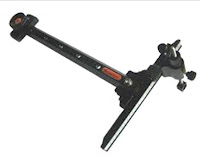
Bryn : Can you click it? Yes you can!

Hi folks, I thought I’d put together some of my thoughts and experiences with clickers in the hope that some of you may find it useful.

A little background on me first though. I did a beginners course back in Feb/March 2012 at 2020 so have been shooting for about 10 months. After my beginners course I shot an 18lb club bow for a while before moving up to a 24lb for about a month then bought my own bow in June. I shot this for a few months and then added a clicker in September. I usually shoot three or four times a week.

Oh and here’s the disclaimer. What follows is not rules or necessarily what coaches may teach about clickers, it’s purely my own experiences and thoughts that have resulted from my own explorations and I continue to learn more with every session.

When to add a clicker

This is a matter of much debate and the argument rages on many archery forums. Some folks say to add a clicker straight away, while others say to let your draw and form stabilise first.

For me, as I mentioned above, I shot my bow for about 3 months before adding a clicker. Before I added a clicker I had gotten to a point where my draw and anchor were pretty stable and my arrows were grouping well horizontally. However, although I thought my execution was pretty repeatable I was having quite a few issues with vertical grouping due to differences in back tension on each shot. The logical solution was to add a clicker to regulate the draw length and the amount of power I was transferring to the arrow. W

I think if I’d have started with a clicker when I got my bow then it would probably have been more of a distraction than a help as there are so many other factors to work on at that stage.

The purpose of a clicker

Many a school teacher has stated, “That bell is not to tell you when you can leave it’s to tell me when I can release you” or words to that effect. In my view the same goes for clickers and admittedly this can be seen as a matter of semantics but the key thing is about who’s in charge here.

Before I added a clicker I spoke with a lot of club members and asked their view on clickers. I heard tales of people tending to release when not fully sighted on the target because their clicker had clicked. This set up a bit of a challenge to me to not be controlled by the clicker. So I gave myself a little mantra and an exercise to avoid this. I told myself that the clicker was to indicate when I had reached a certain repeatable draw length and not to tell me when to execute the shot.

And here’s the exercise I went through to impress this on my subconscious:

1. Nock an arrow and come to full draw.

2. Ensure that the power was transferred to the back muscles.

3. Extend through the clicker and hold for a second, checking the arrow tip briefly to make sure there was no forward creep.

4. Don’t release, come down, un-nock and relax.

5. Rinse and repeat.

Now whilst I obviously do release the moment my clicker clicks it’s proactive rather than reactive when I’m behaving myself. Also if I click early in the shot cycle now more often than not I can hold the draw length and be sure I’m properly sighted before deciding to release.

In the next post I’ll be giving you a whistle stop tour of different clicker types and the benefits and woes of each from my own experience.

Until then – Good ends to all!

Josie: Good Morning Ladies and Gents….

–>

Good morning ladies and gents, my name is Josie and I shall be one of your flight attendants on this voyage. Please read the safety instructions provided and ensure your seat belt is engaged. One of my colleagues will be along shortly with the menu, so sit back and enjoy the ride…
I’ve been shooting with 2020 since last April (2012) after doing the 5-week intro course with Asher. I had shot before back in Devon in a casual way so it was great to finally get a decent grounding in proper archery technique. Immediately afterwards I joined the club and there aren’t many weeks I haven’t shot since. It’s seriously addictive!
My first bow was purchased back in August last year. After much deliberation, questioning club members and a bit of testing I settled on the Hoyt Formula Excel with Formula Excel 30lb limbs; and what a choice she was. I still think she is far and away the best choice for me and I never tire of shooting her.
The starting set-up was quite simple: just the bow, string, Joomong Scorpion sight (which is a good beginner sight if you’re strapped for cash, although the bracket can shake loose if you don’t Loctite it) and a plastic Hoyt Super rest. Since then I’ve added a Shibuya DX button, Spigarelli Evo II rest and Easton X10 long-rod to the equation which has made a considerable improvement. In terms of arrows I shoot Easton X7 Eclipse at the moment, though that will be changing. More on that later.
I can usually be found shooting at 2020 on the weekends; either Saturday, Sunday or both if I have the time. I try to score as often as I can and chart my progress (which isn’t always upwards!) so I have a good idea what effect any changes to my bow or technique make. To give you a rough idea, my very first Portsmouth (shot on 19th May last year) scored 213. On 23rdDecember I shot 500. 
My goal is to try and join the 550 ranks this year. It’s a tough goal but I’m sticking to it. I’ll let you know how it goes!

Our First Club Member Blogger

So, we’ve invited a couple of club members to write some posts for this.. as interesting as I am (!) I don’t get much time to shoot any more so I thought that it would be more useful to have club members doing the posting. We’re also inviting a couple of the instructors to post about their own shooting and experiences teaching. If you’re a club member (or interested in starting) and you’d like to write for this blog just drop me a line and I can fill you in on what you need to do.

The idea is that we’ll ask people to keep track of their experiences in the club and tell us about their equipment and shooting for about 6 months or so. There should be a couple of posts each week (if it all goes to plan).

Our first guest club member to write for us is Josie. She can introduce herself…